

I chose this prompt from among the 100 on offer:
“Simplify, simplify! If you were to let go of three things before bedtime tonight, what would they be? What would you gain by letting them go?”
The prompt comes courtesy of Suleika Jaouad, who recently released her second book, a self-help manual called The Book of Alchemy: A Creative Practice for an Inspired Life.[1] In it, Jaouad encourages readers to use prompts to stimulate both creativity and healing. I don’t use writing prompts and never read self-help books. But I picked up the book and decided to give one of the prompts a try, having been greatly moved by Jaouad’s first book, Between Two Kingdoms, a memoir published in 2021.
The memoir[2] centres on Jaouad’s diagnosis of leukemia when she was only 22 years old. You don’t need to read it to understand what she’s doing in her self-help book, but maybe it’s good to know a little background. In Between Two Kingdoms, Jaouad writes about the three-and-a-half years she spent largely in hospital, her sessions of failed chemo, a bone marrow transplant, a column she wrote in the New York Times called Life Interrupted, and the strain her illness put on her relationship with her partner, whom she calls Will.
Four years later, when she’s declared cancer-free, Jaouad decides to undertake a brave and wacky project. She’ll spend 100 days driving around the United States on her own to meet people who got in touch after reading her Times column. Along the way, she’ll drop in on other cancer survivors, seek out people who’ve lost family members to the disease, and visit a prison inmate whose incarceration on Death Row makes him identify with her long isolation in hospital.
Her guts and perseverance touched me throughout the memoir, and I enjoyed her sense of humour, but what I found especially moving were Jaouad’s repeated attempts to help other people make the most of their lives while she tried to make the most of hers.
Now she’s published The Book of Alchemy, another heartfelt attempt to help.
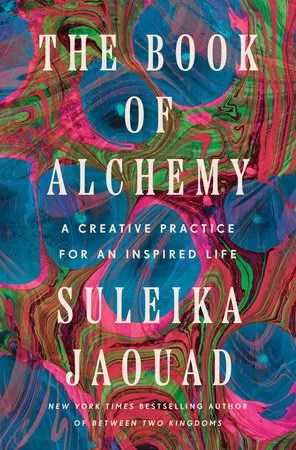
The book began as a newsletter Jaouad started during the early days of the pandemic called the Isolation Journals. She asked accomplished artists to contribute an essay and a prompt, and suggested that her subscribers try them.
Now, in The Book of Alchemy, she’s put the project between covers. Chapters of catch-up on Jaouad’s post-road trip life are interspersed with the essays and prompts from her magic number of 100 people[3], writers and artists ranging from the respectably semi-known to Salman Rushdie, Lena Dunham, the musician Jon Batiste—Jaouad’s husband—her good buddy Elizabeth Gilbert, and icons like Anne Patchett, Mavis Staples and George Saunders (for a start).
Each writes a short autobiographical essay about something crucial they experienced and an insight they reached. Then they offer prompts that they—and Jaouad—hope will spawn insights in others. She encourages readers to dedicate 100 days to the book, working their way through one prompt daily. Her advice: Pull out the book first thing, pre-coffee. Grab your pen and paper, turn to your new prompt and spend ten minutes writing or drawing unselfconsciously.
I can imagine this being an excellent stimulus for people who feel repressed creatively and worry that others will criticize in their writing. Don’t over-think, Jaouad says, just follow the prompt. No one has to see what you’ve done. If you want, toss it. But maybe the exercise will prove inspiring?
I don’t need prompts myself. I’ve never had enough time to write, and it builds up inside. I’ve always had work and family obligations, which lately include being the main caregiver for my husband, who has progressive MS. When I have some writing time, it’s such a relief and a pleasure that I just sit down and get on with it.
I’m also jealous of my mornings, which start very early with a strong cup of tea. I need to do Wordle, insist on depressing myself with the day’s news and enjoy half an hour reading a book that has nothing to do with anything I’m working on. (At the moment, The Marriage Question: George Eliot’s Double Life by Clare Carlisle[4].) Afterward, I have to get up and make breakfast, do medical stuff for my husband, help the thrice-weekly home-care nurse and sometimes a PSW, then take a deep breath and start the day’s activities.
Lately, this has meant continuing our house purge. That’s why I chose the simplicity prompt from Barbara Becker,[5] a writer and hospice worker. Becker writes about the time she and her brother were clearing out their parents’ house, her mother and father having died within weeks of each other earlier that year. She found it hard to get rid of anything.
“Then I reached for my father’s dog-eared copy of Henry David Thoreau’s Walden. I opened right to a page heavy with underlining. There in there centre of the page was Thoreau’s exhortation to ‘Simplify, simplify.’ My father had even put a penciled star in the margin next to those two words. It seemed nothing short of a visitation from these two wise men, Thoreau and my dad: a reminder that by paring down the complexity of life—whether that be the material possessions or the clutter of unnecessary busyness—we will arrive at what’s truly essential.”
The prompt follows: Which three things are you going to let go of before bedtime tonight?
I’ve written about our purge before,[6] which is an ongoing, multi-purpose, multi-tasking effort. If I’m hit by a bus tomorrow, I don’t want to leave a mess for our son like the one Becker and her brother had to deal with, so stuff is being shed.
I also keep thinking of a story about friends of friends who were downsizing, selling the family house and buying a condo. After they did a purge and the real estate agent staged their house, the couple came back and marvelled at the clean new look, one saying to the other, “Why didn’t we do this years ago so we could enjoy it ourselves?”
There’s also the fact our family is changing, with the next generation developing children, so no one sits down for meals anymore and I just do buffets. We don’t need a formal dining room, but we need more places to perch. In his motorized wheelchair, my husband also needs good flooring and plenty of ground to manoeuvre.
All this means that that I flew into this latest purge period thinking about shedding, revamping, renewing and making the first floor more accessible for my husband. I also talked about it too much with friends, which is why one friend suggested I read Jaouad’s memoir, my over-busy role of caregiver in mind.[7]
Between Two Kingdoms is rich with relationships, and details Jaouad’s reliance on her Swiss-born mother, Anne, an artist, and her Tunisian-born father, Hédi, a French professor at Skidmore College. There’s also her relationship with a man she calls Will, which is both point and counterpoint to the story of her illness. They meet at a party not long after Jaouad graduates college and is preparing to move to Paris, where she’s intent on becoming a foreign correspondent.
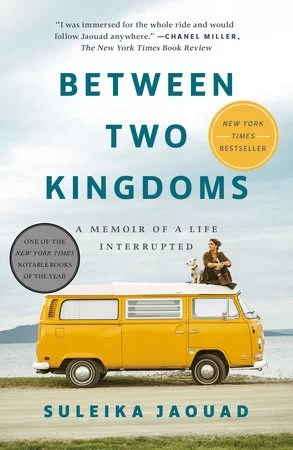
Will quickly follows her to France, even though they hardly know each other. He’s very tall and speaks Mandarin, having worked in China. Joauad describes him as part jock, part intellectual and part class clown. It’s all picture-book romantic (Paris! A loft!) although for some mysterious reason, Jaouad’s skin itches painfully and she frequently collapses into naps
When initial tests prove alarming, Jaouad returns to the States and is diagnosed with acute myeloid leukemia. Will flies home to join her, and remains amazingly present for most of Jaouad’s treatment. My friend was right: I was pulled in by Jaouad’s portrayal of her fear, her pain and her guilt about inflicting suffering on others, which at times reminded me of my husband’s journey. Also by Will’s gentle support, his guilt about not being perfect and his imaginative attempts to ease Jaouad’s suffering, much of it with dignity and grace.
At least he does until his patience runs out. After another health setback, Will tells Jaouad he’s going to California to visit his parents. It isn’t clear when he’ll be back.
“To be a patient is to relinquish control,” Jaouad writes, “to your medical team and their decisions, to your body and its unscheduled breakdowns. Caregivers, by proxy, suffer a similar fate. But there are crucial differences between the two. More than ever, I wanted to walk away: from the changing treatment protocols and timelines, the exhaustion and humiliation of having to ask for constant help. But as a sick person, I was bound to the mess of it all… As a caregiver, Will had been there out of love and also, perhaps, from a sense of obligation. The continuous refrains of ‘You’re a saint for sticking by her—a good man, a model partner,’ surely did not lessen the pressure he must have felt. But being here, enduring this with me, was a choice. The truth was that he could leave. And he would.”
It’s not an unusual pattern. A widely-cited study published in 2009 by the Fred Hutchinson Cancer Research Center and the University of Washington published tracked 515 people suffering from brain tumours, other solid tissue tumours and multiple sclerosis. According to the journal Science Insights, among women who were diagnosed with these illnesses, 20.8% ended up divorced. Only 2.9% of the men did.[8] Women caregivers tend to hang around. Men usually, but not inevitably.
Yet Between Two Kingdoms has a fairy-tale ending on the romance side, which sits happily alongside Jaouad’s remission. Not long after Will leaves, she reconnects with Jon Batiste, whom she knew when they were in a school music program, and who has just been hired as musical director on The Late Show with Stephen Colbert. Joauad’s self-help Book of Alchemy records their marriage, although it also brings news that her cancer recurred. A few years after her road trip, she went through a second bone marrow transplant and achieved a further remission.
Jaouad’s most recent Substack newsletter records her latest news. Her cancer is back and she’s about to undergo her third bone marrow transplant. Now 38 years old, she’s been living with cancer flares and remissions for 15 years.
Against this, my small story of purging looks very small. But it’s also what both illness and caregiving are often like: an accumulation of small tasks carried out one after the other after the other. So, even as my husband was briefly hospitalized with an infection, I called in family help and hired a couple of excellent tradespeople to do a revamp. We installed new kitchen flooring and glossied up the paint, moved furniture around, did some furniture fixes, and during all this, I took a load of smaller things to the basement until I could figure out what to do with them.
Which brings me back to the prompt. After my cup of morning tea/Wordle/groaning over the latest news, I eschewed my book (sorry, George) and went down to the basement for a look at what’s currently crammed there. Following Barbara Becker’s prompt, I planned to simplify my life, at least a little, choosing a couple of things to keep or recycle or discard.
Reader, I failed.
I think it’s called decision fatigue. Looking at the shelves of dishes and tchotchkes, I had no idea what should stay and what should go. I realized how tired I am. How exhausted, both mentally and physically. Slumping down in a chair that has to be moved back upstairs (where?), I wondered if there was another prompt in Jaouad’s book I might manage.
Slowly, something floated to the surface. A line about turnips and charisma? I couldn’t help smiling, wondering if one of the prompters wanted readers to uncover the charisma of a turnip. Meditate on its superior qualities. Give the turnip its long-denied due.
Had someone really suggested that?
Back upstairs, I found the quote from writer Martha Beck, whom Oprah Winfrey calls “one of the smartest women I know.” Beck suggests that readers write about something they tried to learn even though it didn’t interest them: “a subject in school, a religious doctrine, a lecture from a coworker with the charisma of a turnip.”
One of Jaouad’s underlying points is that the prompts are meant to be playful, to loosen people up. While Beck’s prompt will no doubt help others, I preferred the idea of interrogating a turnip for its charisma. Turnip rizz.
Since I had to go to the fruit and veg store anyway, I added turnips to my list. I thought about making my mother’s old-fashioned beef stew for dinner. Felt more energetic as I walked out into a warm fall day. Reaching the store, I found that turnips were sold in packages of two, brought a pair home and gleefully started to play.
First, I contemplated the turnips on the counter, interrogating them for rizz. Then I wondered if I ought to put them on a nice plate with some basil. Or maybe one of my rosy flowered dishes to bring out their blush. Yes No?
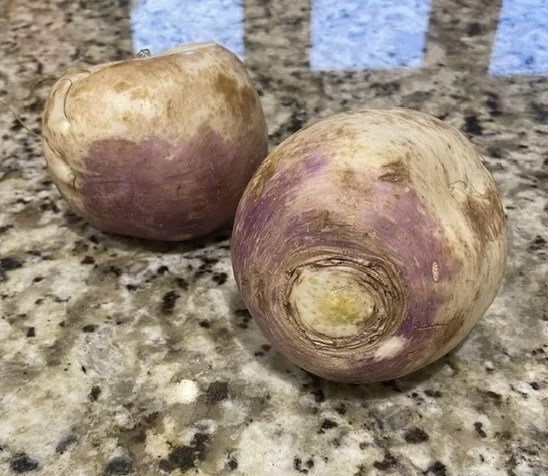
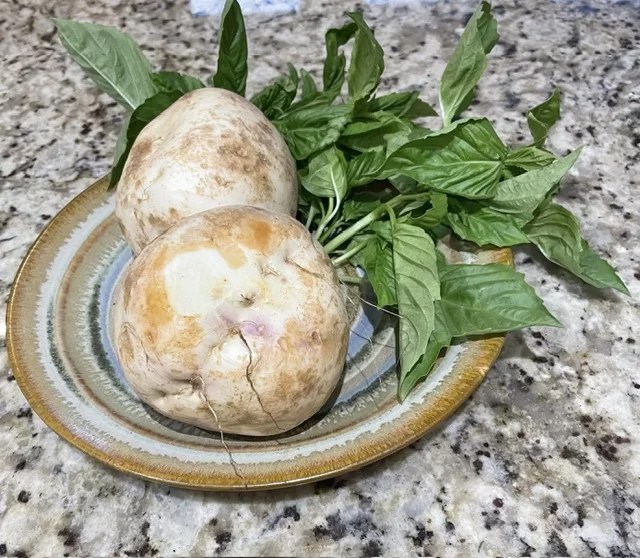
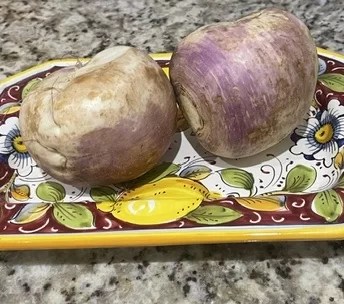
The poor turnips, being made fun of. They began to assume a certain dignity in the face of my disrespect, and I thought of a boy I had known in university, a young man. Tall, a bit podgy, not good looking. He was earnest and not particularly clever but he persevered, he was dogged. He had a pleasant speaking voice. Did what he was asked. Not much more.
Thinking of him now, so many years later, I realized he knew what people thought of him, and that he maintained his dignity in the face of other students’ casual contempt. I’ve never written about a character like him, but as he came to mind after so many years, I thought I should try to capture someone similar in the next thing I write.
Call him Turner? Maybe her.
Still thinking about my character, I put away the turnips, deciding to cook a stew tomorrow, a frittata tonight. After taking Jaouad’s self-help book up to my study, I felt pleased that one of her prompts had worked for me, or that it might, sending silent thanks to Suleika Jaouad, along with very best wishes for her recovery.
And for readers, here’s a bonus. Three prompts you might try.
From Suleika’s father, Hédi Jaouad, who writes an essay about his early years in Tunisia:
“What role did superstition play in your childhood? Was it indulged by the adults around you or scoffed at? Do any of those early beliefs still hold sway? Write about them, and why.
From journalist Jia Tolentino:
“Go outside for fifteen minutes, at sunset if possible, and pay attention to nothing buy your immediate surroundings. Write down what you see and what it makes you think of. Try your best to avoid extrapolating useable meaning for one. Just be an eye.”
Finally, from actor and writer Lena Dunham:
“Write about a public figure you’ve long been fascinated with from afar. What first drew you to them, and why? How has the fascination evolved? What does it tell you about yourself?
It sounds as if Rachel Cusk took a prompt like Dunham’s in writing her latest novel, Life of M, which is widely through to be based on the career of Natalie Portman.
But that’s another matter for another day.
[1] The Book of Alchemy by Suleika Jaouad is published by Random House. You can order a copy here.
[2] Between Two Kingdoms is also published by Random House. Order a copy here.
[3] The 100-project idea originated with designer Michael Beirut, although he partially disclaims it. In The Book of Alchemy, he writes, “I’m always amused when I get credit for coming up with the 100-day project, because part of what makes it interesting is that there’s nothing original about it. It’s what we all do every day. We do routine things, and we do things that require acts of imagination that we’re never going to do again, whether it’s naming a goldfish or responding to a stranger tripping over a curb. Toggling between such routine experiences and unique ones are what, in the aggregate, constitute life.”
[4] You can get a copy of The Marriage Question here.
[5] Barbara Becker is the author of Heartwood: The Art of Living with the End in Mind. Find out more here.
[6] You can read my piece about purging here.
[7] Book publicists say this is the best way to find readers these days: through personal recommendations from friends who feel you might like a book. So if you’ve enjoyed a book recently, writers around the world will thank you for recommending it to your friends.