

The story opens with the narrator driving home along the highway from vancouver, the so-called highway of tears where her Twin and so many other Indigenous women have disappeared. Her Twin went missing four years before, and now her body has been found.
“vancouver” and “Twin” aren’t typos, but represent writer Crystal AJ Smith’s decision to put white terms in lower-case letters while capitalizing family relationships, setting out her priorities in her moving debut, Gitwaałtk,[1] which i’ll follow here.
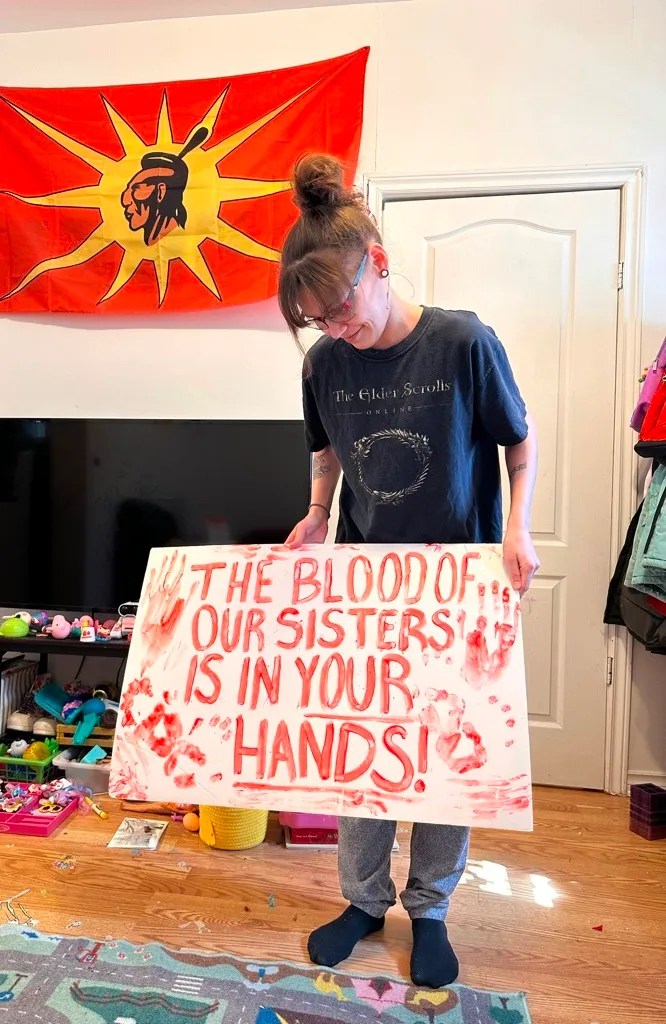
Smith, pictured above, is a member of the Haisla nation[2] of northern british columbia., and lives with her partner and their four children in the town of Liǧʷiłdax̌ʷ. Gitwaałtk is her searing debut, a book about the unnamed narrator’s pain at losing a cousin so close they’re known variously as Sister-Cousins, Sisters and Twins.
The story follows the narrator as she searches for clues to the identity of her Twin’s killer, meanwhile gaining a closer understanding of her own culture and language. The book isn’t didactic. Instead, an increasing number of Indigenous words begin to appear, often untranslated, as the narrator sinks deep into her Grandmother’s teachings.
One of the questions I had in reading Gitwaałtk concerns Crystal Smith’s intended audience. Another was how to reach them. A literary work, a novella, a story told in two languages: how do you get people to read it?
I put these questions to Smith’s publicist, Selena Mercuri, who offered some fascinating ideas that should help other writers, and give readers an idea how books end up in their hands.
But first, the novella itself.
After her arrival home, Crystal Smith’s narrator feels called upon not only to discover who killed her Twin, but to retrieve the hair he cut from her head as a sick type of souvenir. Afterward, she has a sense that her Twin wants her to kill the man in revenge.
Put that way, the book starts to sound like your traditional white-knuckle thriller. So maybe i should add that the detectives who help the unnamed narrator find the murderer are otters, naxnoonax the narrator summons from the riverside who say “Yo, you called?” when they appear.
More important are the little people, mysterious shape shifters who live in the mountains, supernatural beings known to save endangered children, but also to transform into sirens who can lure men to their deaths.
In other words, Smith’s book is a fable. A short, literary fable. It’s also an angry one, although fortunately it also has a sense of humour. We’re often comforted by the narrator’s wise Grandmother, “who always said that white man’s school was just a supplement, kind of like how people take vitamins just in case they don’t eat enough.”
In short chapters, Smith goes deep, touching on the abduction of Indigenous children into residential schools, and making the historically-important number 1492 the key to the mystery of the Twin’s death. (“It was fourteen hundred and ninety-two/when columbus sailed the ocean blue.”)
But at its heart is the rape and disappearance of untold numbers of Indigenous women across canada and in the united states, along with the racism they experienced not only in life but after their murders, when police and governments repeatedly failed to search for either their killers or their remains.
May 5 is Red Dress Day,[3] so just a couple of days ago the ongoing issue of the many murdered and missing Indigenous women made headlines again (as of course it should daily, just as we need to celebrate International Women’s Day on more than March 8, Black History Month beyond February, and so on).
In the novella, Smith’s unnamed narrator follows hints from the otters, receives a tip from a woman working for the police—an ally who risks her job to pass on information the cops have withheld—and finally breaks into a suspect’s house to find her Twin’s long and beautiful hair. The discovery doesn’t just identify the killer. Getting it back means that the Twin is now complete and can pass into the afterlife.
Yet once the narrator has found the hair, she faces a dilemma. Can she bear to kill the killer and become a murderer herself?
It’s a lot to cover in 59 pages, and at times the beats can feel more like wish fulfillment than earned by the story. But it’s a fable, so we accept that, and we can join the narrator in celebrating the voyage of her Twin into the next world.
That brings us back to the question of “we.” Who are Smith’s readers? And how can she reach them?
_________________________________________
Selena Mercuri is a Toronto-based writer of Cuban and Italian background. She’s published short stories in numerous literary journals, and is currently working on her MFA at the University of Guelph. She also works as a freelance publicist for publishing houses across Canada.[4]
I asked her a series of questions about working as a publicist in the current difficult, shifting market. Here are her thoughts.

When you prepare to publicize a book, how tightly do you define the audience? Do you need to focus on the most likely readers? Or do publicists need to go wide, just in case?
In preparing to publicize a book, my first step is to review any materials the publisher provides me with—media kits, title information sheets, author bios, early endorsements. If the author has published before, I look closely at what kind of coverage those titles received. I spend a good amount of time with the book, and once I’m familiar enough, I look for comparative (comp) titles to situate it in the market.
I always try to think broadly in terms of audience and scope. A book is rarely just one thing—it might be a novel about climate collapse, but it’s also about grief, or girlhood, or belonging. So while I anchor the campaign in a clearly defined readership, I also build outward, targeting adjacent audiences and unexpected angles. That might mean pitching beyond strictly literary spaces into cultural, political, or even lifestyle media, depending on the book.
It’s equally important to know the author well, especially when it comes to regional media and existing relationships. I always look at where the author has published previously and prioritize pitching those spaces as well, since there’s often already familiarity or goodwill there. That, combined with an understanding of the author’s background, location, and community ties helps ground the campaign.
Do you work in conjunction with the editor on defining an audience? With marketing? How much falls on your shoulders?
Because I’m a freelance publicist working with different publishers across Canada, my position is a bit more removed than someone in-house. I’m usually brought on once the book is already fairly defined editorially and positioned by the publisher, so I rarely interact directly with editors, and only occasionally with marketing teams.
That also shapes how responsibilities are divided. In publishing, marketing and publicity are distinct. Marketing typically refers to paid efforts, such as advertising, sponsored content, and paid placements. Publicity is centred around earned media, meaning reviews, interviews, features, and other coverage that isn’t paid for. My role sits firmly on the publicity side.
What can you ask a writer to do, and what do you feel remains your job?
I’ve had the pleasure of working with so many wonderful writers in my career so far. When I’m onboarding a new client, I will often invite them to submit a wishlist to me—this is basically a list of places they would like me to pitch and/or contacts they may have an existing relationship with.
Apart from that, I might ask them to share a list of topics tied to the book that they would be comfortable speaking on or writing about.
Once I book an opportunity for a writer, I’ll communicate all the details and expectations but it’s on the author to keep track of their schedule, meet deadlines, and show up prepared.
In general, do you share your feelings about a book’s likely audience and reception with the writer? I can imagine that some writers might find it depressing, especially when they’re new, since sales figures show that most books sell fewer than 1,000 copies.
It depends. Some writers I’ve worked with have wanted a lot of transparency during our initial conversations—mainly regarding what kind of media might be realistic—and others have been much more hands off. I try to remain flexible and adapt to the needs of each writer I work with.
When it comes to reception, though, I’m careful. It’s incredibly difficult to predict, and I don’t think it’s especially useful to present a definitive outlook when so many factors are outside anyone’s control, such as timing, news cycles, competing titles, and even sheer luck. What I do share is how I’m positioning the book.
I also don’t tend to frame conversations around sales. Most authors, in my experience, aren’t asking me to forecast numbers. Instead, they’re asking what sort of media attention is possible. And the truth is that publicity doesn’t translate cleanly into sales in a predictable way. A single well-placed feature can do more than dozens of smaller hits, or vice versa.
4) The old ways of publicizing books are all but gone. What new channels do you find most useful? Podcasts? Readings? Going to smaller venues?
I always take a holistic approach, reaching out to both traditional and new media. Traditional media includes newspapers, magazines, radio, and established review outlets. Those spaces still carry a great deal of credibility and can significantly shape how a book is received.

At the same time, newer channels have become just as important, especially for reaching engaged and niche audiences. Podcasts are incredibly valuable right now because they allow for longer, more thoughtful conversations and tend to attract listeners who are generally interested in books and ideas. Readings at independent bookstores and in community spaces also often create a more direct and memorable connection between the writer and the audience.
I also think there’s been a shift toward more targeted, community-based outreach. It can be more effective to connect with smaller, highly engaged audiences, whether that’s through Substacks, online reading communities, book clubs, or specialized cultural outlets.
It’s less about replacing “old” channels with “new” ones and more about layering them. A strong campaign uses a mix.
What about newsletters? How useful to a writer is a newsletter? I write mine because I enjoy doing it, but I’m not sure it sells many of my own books. Can you persuade me? (There are lots of out-clicks on the books I review, so don’t get discouraged.)
Newsletters can be incredibly useful, but I don’t think their value is always best measured in direct book sales. Like publicity more broadly, the impact is often indirect and cumulative. A newsletter builds a sustained relationship with readers over time. It gives you a space where you control the tone, audience, and conversation around your work, rather than relying entirely on external platforms.
That said, I don’t think newsletters are essential for every writer. If it’s something you enjoy, that’s a huge advantage. But if it’s something you dread, it’s probably not the best use of your energy. There are plenty of other ways to reach readers. For example, essays in magazines, interviews, events, social media, and podcasts.
Finally, as to Crystal’s book. How do you think of her audience, and how are you trying to reach it?
I think Gitwaałtk appeals to a broad audience. At the core are readers of contemporary Canadian and Indigenous literature who are already engaged with these conversations surrounding colonialism. Those readers will immediately recognize the stakes of the novel—its focus on loss, justice, and the ongoing realities Indigenous communities face—and are often the first to champion a book like this.
From there, I build outward. The novel also speaks to readers interested in social justice, activism, and stories centred on missing and murdered Indigenous women, as well as those drawn to emotionally driven narratives about grief and resilience. It blends compelling storytelling with elements that resonate beyond strictly literary spaces.
Crystal herself is also a key part of how I approach the audience. She’s Haisla and Ts’ymsen, adopted into the Heiltsuk nation, and her work as a writer, playwright, and activist, along with her focus on Indigenous leadership and language revitalization, creates multiple meaningful entry points for media. Because of Crystal’s location in British Columbia, West Coast and regional media are a major focus, alongside opportunities for local events and community engagement.
Gitwaałtk tells a powerful story, but it also participates in a much larger conversation that challenges colonial narratives and exposes the gendered violence embedded within them. My goal is to place it in spaces where those conversations are already happening, while also helping it reach readers who may not yet be part of them.
________________________________________________
My thanks to Selena for the insights, including tips other writers should find useful.
And congratulations to Crystal AJ Smith for crafting a modern fable. Gitwaałtk is searching, sad and very moving, with its downhome Aunties, wise Grandmother and young women who fight back.
Not to mention its supernatural otters. I love otters, especially the ones who say, “Yo.”
[1] Again, you can order a copy of Gitwaałtk here.
[2] A high school friend of mine, the late Derek Wilson, was a master goldsmith and carver from the Haisla nation. I wrote one post about Derek and another about The Return of the G’psgolox Pole, the documentary in which he appears.
[3] Writer Tanya Talaga wrote a moving note about this year’s Red Dress Day on Substack. (And I wrote a review of a couple of Talaga’s books here.)
[4] You can read more about Selena Mercuri on her website.