

Does anyone else see their life in cat epochs?
This is the second part of a story about the cats we’ve had in our lives. Last time, I left our family living in Rio de Janeiro, where my husband Paul was posted while working as the South America correspondent for Toronto’s Globe and Mail. Our grey cat Pica had begun his life on a farm east of Toronto and spent his final years in our Rio apartment. He was a particularly elegant cat and I still miss him.
But there have been four more cat companions—at least so far. The next was….
Copernicus. Yes, Copernicus
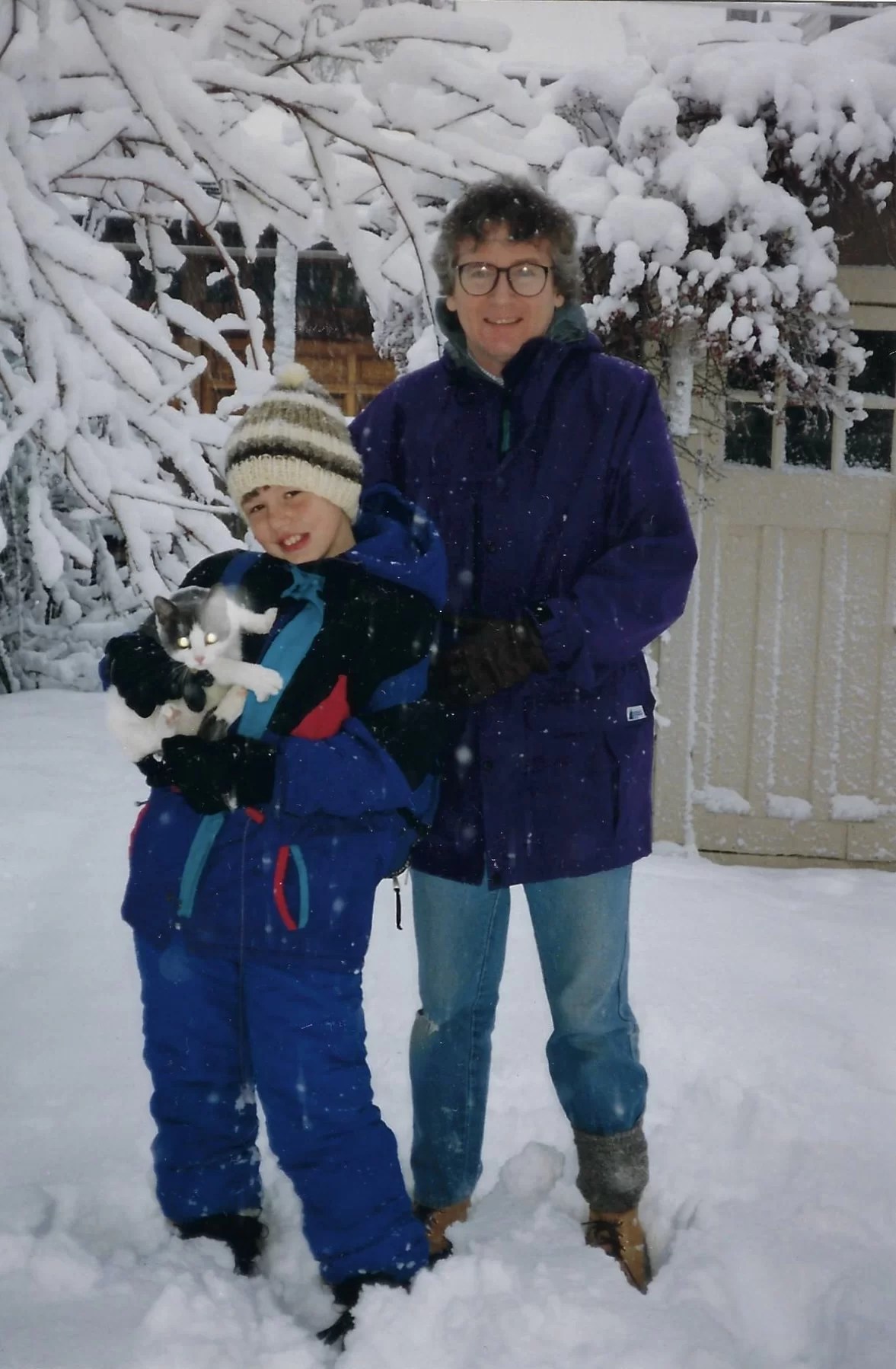
We returned to Toronto not long after lovely Pica died. Our son Gabe wanted another cat almost as soon as we got home, so we went to the Humane Society and he picked out a kitten. This one looked like every black-and-white cat you’ve ever seen, except that he was grey and white, the same steel grey colour as Pica. You didn’t often see a cat with markings so dramatic, and maybe we should have taken that as a warning.
Gabe was eight years old, and for eight-year-old reasons, he named the cat Copernicus. This left me feeling pretty damn stupid, since Copernicus had a tendency to shoot out the door and disappear, meaning I had to roam the streets yelling, “Copernicus! Copernicus!” as I tried to bring him home to a sad little boy.
(“Who’s the new neighbour? Is she a little, you know?”
(“Not sure I want to find out.”)
We left Rio after Paul had been posted there for three years. The paper had offered him a fourth year, and other postings were possible later. But we were concerned that Gabe would grow up rootless, and knew that diplomat’s brats can have problems.
Plus, my miniscule writing career was going nowhere. I’d opened an email account with the new Toronto Freenet not long after we’d arrived in Brazil, but hardly anyone used email yet, and magazines didn’t accept electronic submissions. During one trip home, I’d had a drink with an editor and asked if he’d even got my letters. He’d admitted sheepishly he kept a couple in the pile on his desk that he’d been intending to answer. But I lived so far away, he’d wanted to write a long, gossipy letter, and never got around to it.
Weighed against this, Paul loved his work, and would one more year make a difference? Three years in Mexico, four in Brazil. Why not?
Then something happened. Or at least, it might have A foreign correspondent’s job can be dangerous, and he’d been tear-gassed, robbed at gunpoint and come down with a wicked case of hepatitis from drinking contaminated water in Central America. He’d flown in planes he knew to be unsafe, faced death threats—I answered the phone to one in Mexico—and was kidnapped and briefly held by a pair of ex-Contra guerrillas in Nicaragua.
I’m going to write about that next time, since I’m reading a novel set partly among the Contras and plan to review it. Stay tuned.
But there came a time in Colombia shortly after the military had taken out a major drug trafficker in his mountain redoubt, a narco known as El Mexicano. The narco was Colombian, but he was famously a fan of everything Mexican. Hearing reports of his death, and receiving assurances that the army was patrolling the area, Paul and three other correspondents decided to drive into the mountains. They planned to talk to the residents of the village where he’d been based, asking what it had been like to live under the trafficker’s dominion.
They were about half an hour from the village when Paul suddenly thought, What the fuck am I doing? El Mexicano had only been killed two days before—presuming the reports of his death were reliable. He asked himself if some of the narco’s lieutenants might still be there. If he and his friends should have looked into the situation more thoroughly. But the other reporters were keen to do the story. He decided he was being irrational and kept quiet.
Everything was fine. El Mexicano was indeed ex, and some of the villagers told them he was a jerk while others liked the way he’d thrown money around. There were also an unusual number of Mexican restaurants in that little mountain town.
Yet this is when the romance began to leach out of Paul’s job, and the stress levels grow too high. Aside from anything else, the logistics were grueling. Getting to places he needed to go. Getting his stories out.
So we moved back to Toronto, and Gabe named his new cat Copernicus.
***
By the time we got home, people were starting to keep their cats indoors. We didn’t do that, not at first. Yet it soon grew clear that when Copernicus went out, he didn’t pencil a return date into his agenda. We’d had him neutered, but he was still a brawling tough guy. If he’d been human, he would have been a chancer, a mobster, a full-patch Hell’s Angel. That cat cost us a fortune in vet bills, returning scratched-up and bitten, incubating infections. He upset Gabe repeatedly, and we started trying to keep him inside.
But if you open the door carrying too many grocery bags, a cat can easily snake between your legs and make a run for it. Copernicus kept disappearing, although he always came back, usually a day or two later—until he didn’t.
“Copernicus! Copernicus!” Patrolling the streets.
A week passed. Two. No one responded to the posters we put up. This time he was gone, and I assumed he’d been hit by a car. We’d only had him for a couple of years as we’d settled back into Toronto. Still, Gabe was so upset he wouldn’t even go into the pet food aisle at the supermarket.
So we went back to the Humane Society and got another kitten.
Woody
Woody was one of those black-and-white cats you see all the time, but a particularly delicate and sweet one. We brought him home as middle age leaned in, that period when you’re juggling a young kid, multiple jobs, family obligations and a busy social life. It turned out that Woody had an instinct for finding the exact right time to jump up beside you on the sofa, reaching out a gentle paw to touch your hand. Yet he’s the cat I remember least, living out a quiet little life amid the family chaos.
The housing market was in bad shape when we got back, and instead of selling our rundown old house, we added to the chaos by undertaking a series of renovations. As old plaster walls came down, Paul spent a couple of years working in The Globe’s Toronto office. Then he got restless and went back on the foreign desk, based in Toronto but travelling to cover stories around the world. He flew from covering a South African election campaign to the U.N. general assembly in New York, where he excavated the subtexts of their coded and contentious meetings.
Meanwhile I published my first novel and started drafting the second, working as a freelance magazine journalist as our renovations went serially over budget. (Has any renovation ever gone under budget?) Our trips were scheduled so one of us was always at home, taking care of Gabe and feeding Woody.
There was something else going on, too. Given what we’d been through in Latin America, both Paul and I began volunteering for human rights groups. I was elected to the board of PEN Canada, driving to Ottawa to lobby the Canadian government on behalf of writers imprisoned abroad, flying off to international congresses and working on fundraising events in Toronto.
Gentle Woody was always there in the background, and as I look back on my human rights work, it occurs to me that this was something we had in common. I was in the background too, a barely-published writer finding myself moving among literary giants: listening, watching, trying to learn.
One time, I was one of a small group who met with Nobel Prize-winning novelist Nadine Gordimer as she passed through Toronto. Over coffee—I can still see the white cloth on a round table—Gordimer asked a series of incisive questions about the Canadian government approach to international human rights.
A couple of senior people fumbled out answers. To be fair, this wasn’t their department. They fundraised. They handled domestic issues.
Gordimer was visibly unimpressed. In the silence, I dared to lean forward and say a few words. This was actually my area, and as I answered, she saw that immediately and shut out the others, asking me more questions. Afterwards, she thought for a moment and nodded, then absent-mindedly whistled a few bars of an old song.
My Aunt Marg used to whistle like that. She and Nadine Gordimer were the only women I’ve ever met who did. They were about the same age, both of them petite and tart. A little of my fondness for my aunt attached itself to Gordimer, although the others seemed rather cowed.
Another time, I was charged with asking Turkish novelist Orhan Pamuk whether he would say a few words at a PEN Canada event. Pamuk would be awarded the Nobel Prize for Literature a decade later, in 2006. At the time, he was in town to read at the Toronto International Festival of Authors, and I going to interview him onstage.
It would be difficult—perhaps even dangerous—for Pamuk to speak at the PEN event, where the human rights record of Turkey’s government would be criticized, and consular officials would be in the audience. Someone must have decided to be kind. He would find it easier to turn me down than to refuse a request from, say, Margaret Atwood. I can still see panic passing briefly through his eyes. Then he raised his chin, firmed his lips, and accepted.
I have very interesting journals. I wrote everything down, recording the words of bold-face names as I slipped through the world like Woody. Like Woody Allen’s Zelig in the film of that name, a witness to fascinating moments in history, trying to learn from what I saw.
There was also the time I spent the evening of my 40th birthday driving Michael Ondaatje and Susan Sontag around Toronto. Sontag had flown here to join Ondaatje in headlining a PEN Canada benefit, this one to raise money for writers under siege in Sarajevo. After it ended, they wanted to find a bookstore that was open late, and I drove them from one closed store to another.
As I did, Sontag told Ondaatje about her most recent visit to Sarajevo, during which she’d smuggled in a money belt packed with 60,000 Deutschmarks, about $100,000, to help local writers buy food and medicine. She didn’t say it, but she could easily have been murdered, either by the Serbian army that was besieging Sarajevo or by a garden-variety thief. Sontag spoke extemporaneously, conversaionally, but in beautifully-composed sentences that formed complete paragraphs, her words trenchant, her voice a resonant alto. She often laughed. She could be very funny.

Meanwhile, Michael Ondaatje asked her a series of questions, making quiet but equally fluent observations, casual and wry. He was clearly enjoying her company, and paying attention to a degree I would only understand later.
This was at a different event, when Ondaatje came up to me and said, “Hi, Lesley. How are things?”
He’d remembered my name when the other bold-face writers never did. I was so shocked I blurted, “I’m a little intimidated, frankly, by all the famous people in the room.”
Meeting his eyes, I felt like a complete idiot.
“Present company not excepted,” I said.
Ondaatje chuckled and answered, “One gets used to it.”
To a degree, I did. I stopped being so intimidated, but I never felt part of things, although I know I shouldn’t sell myself short. I’ve always been well-organized and hard-working, and I got things done. Aside from anything else, I published three books during this period with increasingly-established publishers, the third one with Penguin.
But we’re talking about Michael Ondaatje and Susan Sontag here.
Who, by the way, discovered during that car ride that they both liked to write in green ink.
***
So here’s the question. What did I learn during those chaotic and glamourous years? The power of green ink aside.
For one thing, rigor. Those great writers approached the world with rigor, always watching, always insisting on seeing what was there, no matter how inconvenient it might prove–something that grew unmistakeably clear after I flew to Prague as part of the Canadian delegation to an International PEN congress.
Another delegate was writer and translator Paul Wilson, who knew the city well. Wilson had moved to what was then Czechoslovakia in 1967. He’d got to know members of the anti-government underground, becoming the lead singer in the band, the Plastic People of the Universe, before being expelled from the country in 1977. Now, years later, he took our delegation to meet his friend, Czech President Václav Havel, in the presidential office.
Havel had been elected president of the former Czechoslovakia in 1989, and was then serving as the first president of the reconfigured Czech Republic, ultimately holding office from 1993 to 2003. As a playwright and dissident, he’d suffered through multiple incarcerations during the former communist regime. Now he was the leader of a democracy, the walls of his office painted with a humorous mural of life in the new republic.
As the others talked, I walked around enjoying the mural, pausing when I saw a photograph of U.S. President Bill Clinton taken in Havel’s office and hanging above a small table. The picture had been positioned so that when you looked at it, you stood exactly where Clinton had been standing.
Maybe Havel liked to see whether people picked up on that. When I glanced at him, I realized he’d been watching me. Now he smiled and beckoned me over. Wilson translated an introduction, after which I pointed out that the only writer in Havel’s mural was a spy, taking notes while he watched others.
Havel didn’t seem to like that. Then Paul Wilson added something in Czech, apparently making clear what I’d intended to say: that writers are spies, nosy, eavesdropping, rubber-necking other peoples’ behaviour and writing everything down. Now Havel was amused, and we continued to chat. He was a small man but a powerful presence, honorable and droll.
A few days later, at a PEN dinner, playwright Tom Stoppard stopped by the table where I was sitting. He knew the sister of one of the women at the table, an actress. Stoppard was even more dauntingly handsome in person than in photographs. He spoke gently, but remained laser-focused on the woman as he asked after her sister, shutting out everybody else the way Nadime Gordimer had done.
It was the congress of great playwrights. Arthur Miller stood nearby. Both he and Stoppard were very tall.
I watched them both, being a spy, as unnoticed and insignificant as Woody. Seeing Stoppard play the same game as Gordimer made me realize how intensely these great writers could concentrate, possessed of focus as well as rigor. They were also fending off unwanted attention, weren’t they? Add a coat of self-protection to the mix. Above all, they insisted on seeing what was really going on, acting as witnesses, even though it could get them thrown into jail like Havel, or worse.
Woody lived for ten years in calm counterpoint to this intriguing maelstrom, then spent his final year increasingly ill. He was a kidney cat like our old friend Pica, and no matter how conscientiously we adjusted his meds and changed his diet, the poor little guy grew gentler and quieter.
Finally the vet told us he was suffering; we had to let him go. We went into a quiet room at the back of her clinic, where Woody left our lives as gently as he’d come into them, may he rest in peace.
I’m going to break off now and write about the last two cats later.
Next time, I’ll post a review of The Feeling of Iron by Italian writer Giaime Alonge, which was translated into English by Clarissa Botsford. It’s an ambitious book with action moving from the concentration camps of the Second World War to the battlefront in Nicaragua in 1982, when the Contra guerrillas were fighting the left-wing Sandinista government, with U.S. backing.
As it happens, my husband was kidnapped by the Contras, so I’ll write about that, too.
To jump to part one of the cat story, please go here.